Mayor Prentiss
The Knife of Never Letting GoMayor Prentiss is the ruler of Prentisstown and the architect of a system that turns Noise, education, and the coming-of-age passage into instruments of control. His power is presented first as an unsettling discipline imposed on thought, then as an army capable of taking Farbranch, and finally as a new government at Haven. The revelation that he arranged the town’s killings of boys’ chosen victims gives that authority its most consequential cost: his order is built not merely on obedience, but on making violence part of becoming a man.
Identity and Methods
Mayor Prentiss is described as a man with a distinct point of view and an unusually clear Noise. He believes that Noise can be sorted, harnessed, and put to use. Near his house, Todd hears the Mayor and his closest men practicing counting exercises, imagining perfect shapes, and repeating an orderly chant. To Todd, these routines look like the forging of a small army and perhaps a weapon made from Noise. The exercises therefore introduce the Mayor’s central method: he treats an involuntary and revealing feature of life on the New World as something that can be disciplined into collective force.
That apparent order also carries a threat. Todd experiences the Mayor’s household as a sign that the world is changing in a way that will leave him behind. The contrast is important: Noise ordinarily exposes the unfiltered thoughts men cannot conceal, but the Mayor seeks to make it regular and useful. His authority does not depend on silence in the ordinary sense; it depends on directing what people do with the thoughts that Noise makes audible.
The Mayor also controls what can be learned. After boys had been taught at home and later put in front of educational videos and modules, he outlawed those materials as harmful to mental discipline. The brief classroom established under Mr Royal could not overcome the disruption of a room full of boys’ Noise, and even tests were compromised because students could not reliably keep their thoughts to themselves. The Mayor then ordered every book burned, including books kept in men’s homes. Mr Royal, who had tried to harden himself through drinking, gave up teaching and died by suicide, as Todd initially understands it. The later account overturns that explanation: Mr Royal had been killed as part of the town’s coming-of-age practice. Both the original account and its correction show how the Mayor’s rule reaches into education, public knowledge, and the stories the town tells about its own losses.
From Hidden Authority to Open Pursuit
For much of Todd’s early life, the Mayor is a presence at the edge of ordinary experience rather than a familiar figure. The Mayor’s son, Mr Prentiss Jr, first approaches Todd’s household on his father’s behalf, saying that the Mayor wants to speak with the boy after a word of Todd’s has drawn notice in town. This makes clear that the Mayor’s attention is personal as well as political: Todd is not simply caught in a broad campaign but singled out as someone his father wants brought to him.
Todd later sees the Mayor himself approaching through the trees on horseback, with other armed men mounted behind him. The Mayor’s clean clothes, upright bearing, and composed appearance distinguish him from the pursuing group and suggest a ruler accustomed to being protected and obeyed. After the river bridge burns, he calls across the smoke to Todd and makes clear that their conflict is not over. The exchange establishes direct antagonism while leaving the Mayor’s larger purpose unresolved.
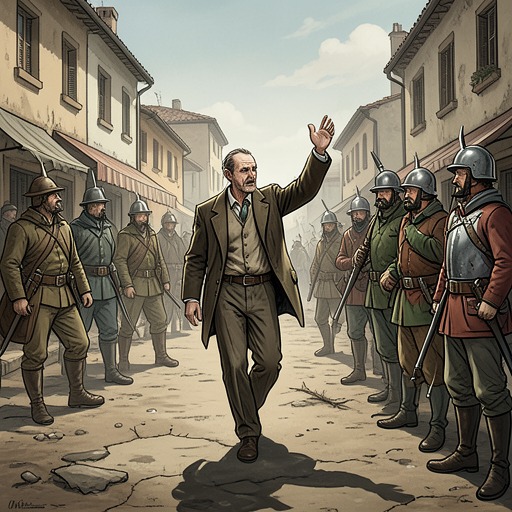
At Farbranch, that private pursuit becomes a campaign of conquest. Todd first sees Farbranch’s people retreating as mounted men advance, followed by ranks of Prentisstown men carrying guns. The force is not a small posse but the town’s men assembled as an army, with roughly three times the population of Farbranch and three times as many guns. The Mayor rides among them without holding a gun. He watches the retreat and leaves the work to the troops, yet his command is unmistakable. His calm presence makes visible the difference between carrying out violence and directing it: he can appear detached from the fighting while remaining its controlling figure.
When Todd later forces Mr Prentiss Jr to answer for the pursuit, the son distinguishes the Mayor’s objective from any broader claim over Todd and his companion. His father wants Todd specifically. That insistence links the invasion and the personal hunt, even as the evidence does not disclose every reason for the Mayor’s interest. The Mayor’s repeated ability to place his son and the town’s armed men in pursuit makes family authority and political force work together.
The Coming-of-Age System
The Mayor’s rule is most fully exposed when Todd learns what happened to the men who supposedly disappeared. Mr Royal did not take his own life: Seb Mundy killed him on Mundy’s thirteenth birthday, while the other men of Prentisstown watched. Mr Gault, who had tried to flee through the swamp, was caught by the Mayor and executed under the law of the New World; the Mayor arranged for his son to kill Gault on the son’s thirteenth birthday. If the town had no captured escapee available for a boy’s ceremony, its men could instead select someone they disliked and claim that he had disappeared.
These revelations show the Mayor’s relationship to violence as institutional and generational. Boys are made to kill in order to become men, while the community’s adults witness the act and sustain the false account surrounding it. The Mayor does more than enforce a rule against escape: he helps make the rule serve the town’s rite, turning captured fugitives and disliked neighbours into victims. Individual boys carry out the killings, but they do so within a structure organized and maintained by adult authority.
The revelation also revises Todd’s understanding of the town he grew up in. A teacher whose death seemed to mark the end of schooling had in fact been selected for a boy’s initiation. Men believed to have vanished had been killed, and the town had concealed those deaths by calling them disappearances. The Mayor’s power thus includes control over memory and explanation: the violence can continue because its victims are misrepresented and its witnesses are part of the system. When Aaron calls Todd the final soldier in God’s perfect army, Todd rejects the religious framing, but the description points toward the Mayor’s design of boys as soldiers in a larger order.
Conquest and the Presidency
The Mayor’s advance does not end at Farbranch. Near Haven, Todd arrives believing an army is still a day away, only to find the Mayor already in the square. The Mayor explains that the rumour of an army can work as effectively as the army itself: the terms of surrender have cleared the streets so that he can welcome Todd in person. The strategy extends his power beyond direct force. The expected approach of an army has been enough to secure submission and arrange the space in which the Mayor will appear as its victor.
The Mayor corrects his former title: he is now President Prentiss. He says that Todd will do well to remember the new title, marking the change from local ruler to claimant over a larger political order. He then presents himself as the newly appointed President of the planet and calls Haven its new capital. The naming of a capital and the announcement of a presidency transform military success into a claim of legitimate government, although the evidence presents the transition through the Mayor’s declaration rather than through any account of how the wider population chose him.
The scene also changes the terms of Todd’s immediate danger. Todd realizes that he cannot hear the Mayor’s Noise or anyone else’s. The Mayor acknowledges that there is an interesting story behind this silence, but does not explain it before turning to the situation at hand. Todd, carrying the wounded Viola, begs him to save her and offers to join the army; the Mayor delays an answer. His control of the encounter is therefore not only military or political. He dictates what Todd is permitted to know and keeps the possibility of help in his own hands.
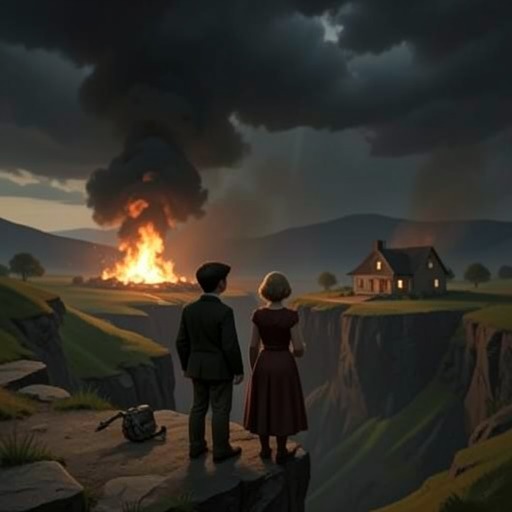
The Mayor ends the novel’s action by welcoming Todd to New Prentisstown. Todd and Viola have run into a trap, and Todd holds her as she whispers his name. The welcome is at once a declaration of conquest and a bitter reversal of the journey: the fugitive who has spent the story trying to escape the Mayor arrives inside a place named for him, under a President who has claimed the planet’s new capital.
Narrative Role and Significance
The Mayor’s power is developed through a widening sequence of appearances. At first it is heard indirectly in organized chants near his house; later it arrives on horseback, directs armed men at Farbranch, and finally speaks from the square at Haven. Each appearance makes a private method more public. Mental discipline becomes command, command becomes conquest, and conquest becomes a declared government.
Todd’s perspective also shapes how the Mayor’s authority is understood. Todd sees his composure and apparent ease, but repeatedly asks how one man can make so many others do what he wants. The answer emerges through the evidence of the school, the burned books, the concealed killings, the assembled army, and the surrender at Haven. The Mayor’s authority is not a single show of force: it is a structure that regulates knowledge, recruits the young into violence, conceals the past, and makes submission appear to precede his arrival. His final welcome concentrates those strands into one image of power—an old pursuer who has turned the destination itself into an extension of his rule.